Construction
Common Patio Drainage Problems and How to Prevent Them
Most patio failures come down to water. Here are the most common drainage problems we see, and how proper design prevents them.
By Patio North · · 3 min read
 Design inspiration
When a patio fails, water is almost always involved. Puddles that never dry, slabs tilting toward the house, pavers heaving after winter, ice sheets on the steps: these are drainage problems first, and surface problems second.
In Western New York, the stakes are higher because water that sits in or under a patio freezes and thaws repeatedly through the winter. Here are the most common issues and how to prevent them.
1. A patio that slopes toward the house
What happens: Water flows toward the foundation, which can contribute to wet basements, and ice forms at the back door.
Why it happens: The patio was built without enough pitch, the base settled unevenly over time, or backfill near the foundation compacted after the patio was installed.
Prevention: A patio should be pitched gently away from the house. A commonly used range is roughly 1/8 to 1/4 inch per foot, with the final value set by the surface material and the design. The base beneath, especially near the foundation where backfill may be loose, needs to be properly compacted.
2. Puddles and birdbaths
What happens: Low spots hold water after every rain and freeze into ice patches in winter.
Why it happens: Uneven finishing, local settling, or a pitch that's too flat to move water reliably.
Prevention: Consistent pitch, careful finishing or screeding, and a uniformly compacted base. On larger patios, drains may be needed where the slope can't carry water off the surface.
3. Frost heave
What happens: Sections of a patio, walk, or steps lift in winter and may not settle back evenly in spring. Pavers become uneven; concrete cracks.
Why it happens: Water in fine-grained soils beneath the patio freezes and expands. The more water and the finer the soil, the worse it can be.
Prevention: Remove unsuitable soils, install a compacted, free-draining granular base, and keep water from collecting beneath the patio. Good drainage reduces how much water is available to freeze.
4. Water from somewhere else
What happens: The patio drains fine on its own, but water arrives from downspouts, a slope above, or a neighbor's yard and floods across it.
Why it happens: The design accounted for rain falling on the patio, but not water flowing onto it.
Prevention: Look at the whole site. Redirect downspouts away from the patio, intercept water from upslope with grading or drains, and give water a clear path around the patio. This is especially important on sloped lots and walkout properties.
5. Patios that trap water against the house
What happens: A patio set too high against siding or a door threshold can direct water into the wall or under the door.
Prevention: Plan finished elevations carefully at every door and wall. Maintain appropriate clearance between the patio surface and siding, and consider how thresholds and steps meet the patio.
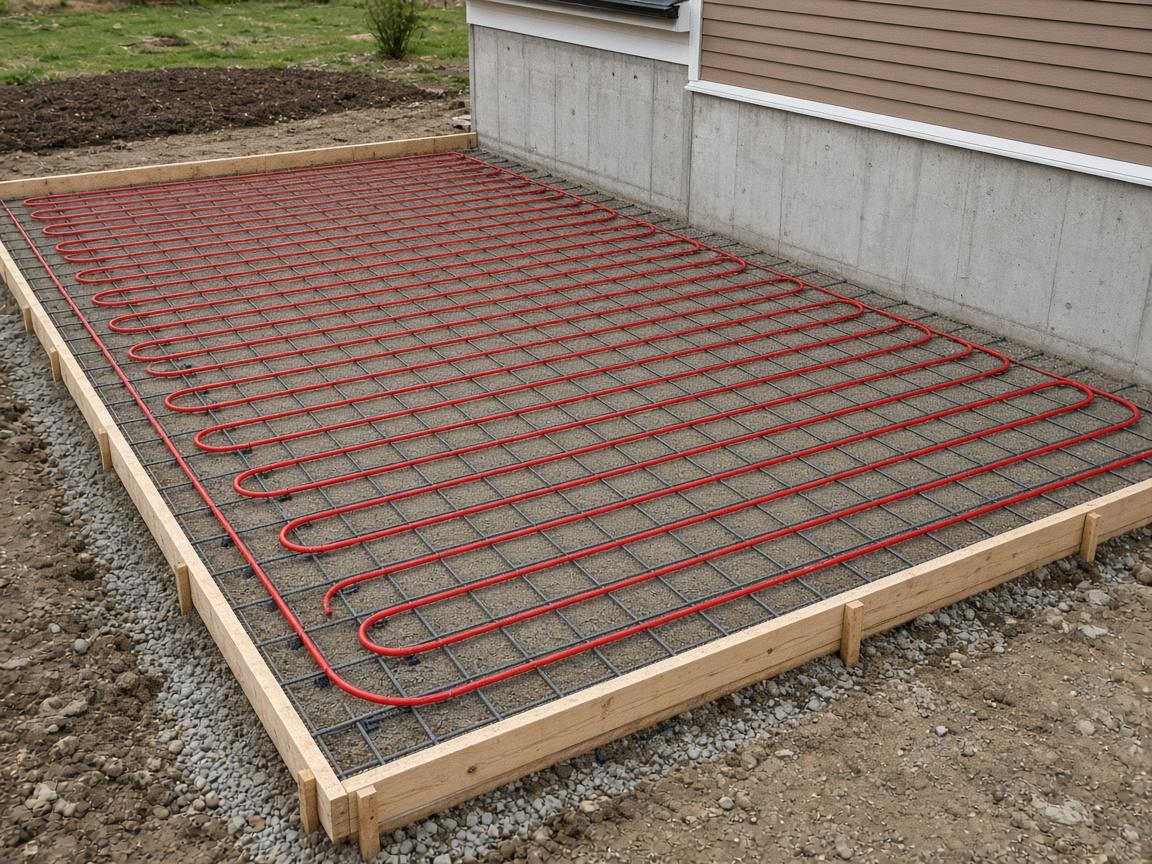
6. Ice at the edges of heated surfaces
What happens: A snow-melting system clears the patio, but melt water runs onto an unheated area and refreezes.
Prevention: Plan melt water drainage as part of heated-surface design. Learn more in how heated driveways and walkways work.
7. Joint washout in paver patios
What happens: Joint sand washes out where water concentrates, leading to loose pavers and weeds.
Prevention: Proper pitch, edge restraints, and polymeric joint sand where appropriate. Avoid directing concentrated water, like a downspout, across the patio.
Drainage tools
Depending on the site, common solutions include:
- Grading the surrounding soil so water moves away from the patio and house
- Surface pitch built into the patio itself
- Channel or trench drains across a patio edge or in front of a door
- Area drains at low points
- Swales that guide water around the patio
- Downspout extensions or underground routing to a suitable discharge point
The right combination depends on where water comes from and where it can legally and practically go.
When to address drainage
The best time is before the patio is built, or when an old one is being replaced. Correcting the base and grade during replacement is far easier than trying to fix it afterward. Read stamped concrete vs. pavers for how each surface handles water and freeze–thaw.
The bottom line
A patio is a surface for water to land on as much as a place to sit. Design for where water comes from, where it goes, and what happens when it freezes, and the patio will look better and last longer. If you're dealing with a patio that already pools or tilts toward the house, replacement is a chance to fix the cause, not just the surface.
Fix the water before you build.
Tell us what you're seeing in your yard, and we'll plan a patio that drains properly.
Request a Quote